Sunday, March 1, 2015

A Bird's Eye View to Wilderness Wildlife Week 2015

Back in January, I decided to take advantage of an unspoken-for weekend and take a short drive down to Sevierville, Tennessee to visit my father-in-law, Norm Kallemeyn. The timing wasn't completely arbitrary. For years Norm and my mother-in-law, Bobbie, had been talking about Wilderness Wildlife Week, which they had attended and volunteered for many years. Bobbie passed away this past June and I was due to visit Norm. I thought January a good time for me to try to break up the gloom of winter with my ever-sunny disposition and cheery attitude (read - sarcasm). If my visit coincided with the 25th annual Wilderness Wildlife Week, all the better.

A "Birds' Eye View" by Clay Thurston (hanging in my man cave)
"Focus" - driving down I-89 at night with freezing rain; the temperature around 32; no snow tires; being passed by semis. It was a long trip to Tennessee from Northern Virginia and I didn't get in until fairly late. It was good to be there and Norm and I got an early start Saturday morning.

Events started on Saturday, January 24th and ran through Saturday, January 31. There were seminars all week, entertainment, hikes in the Smokies, and vendors to visit.

I had identified a couple presentations I wanted to see pertaining to outdoor photography, outdoor writing, wildlife, and the geology of the Smokies. First, Norm had to introduce me to a couple people, about 1,351 or so acquaintances. Not being well-liked myself, it is hard to imagine that many people seemingly genuinely happy to see you. I had to ice my hand that night after so many introductions. I don't know how the politicians do it.

OK, next the bird eye quiz. Yes, I did by this photograph. My wife and daughters didn't quite believe it at first. It is now hanging on the wall. Make your guesses. Write them down - starting top row, left to right. Whoever wins gets my Parakeets or a prize of similar value (which would mean you pay me money). I think I only got 3 or 4 correct.  Here goes, sung to the tune of "Ten Little Indians" (or Ten Native Americans to be PC): Row 1: Brown Thrasher, Great Blue Heron, Mockingbird, Sandhill Crane, Burrowing Owl; Row 2: Carolina Wren, Cattle Egret (breeding colors), American Goldfinch, Tricolor Heron (breeding colors), Robin; Row 3: White Ibis, Mourning Dove, Indigo Bunting, Blue Jay, Double-crested Cormorant (breeding colors); Row 4: Anhinga (female breeding colors), Cedar Waxwing, Saw-whet Owl, White-throated Sparrow, Great Egret (breeding colors); and Row 5: Wood Duck (male), Red-bellied Woodpecker (female), Black Vulture, Cardinal (male), Atlantic Puffin. Let me know where to ship the Parakeets. Their names are Sid and Geno.

Raptor-man's Friend, unhappy
All the presentations I attended were good to excellent. I particularly enjoyed the presentation on "The Dos, Don'ts and Hows of Photographing Birds" by Clay Thurston (865-281-0645). Clay had a ton of great photos and was humble enough to include many "out-takes" where his bird subjects didn't exactly cooperate. Clay imparted several useful bits of information in his presentation. These included how to position the bird in the picture, using the rule of thirds, to highlight the bird's movement and other features of the photo and that you usually have to take a lot of photos to get that one really great shot.

I also attended a very interesting presentation by Norm's friend, and financial advisor, J. Greg Johnson on hiking in Israel and Ireland. OK, they aren't the Smokies, but Greg is a proud Appalachian so that was the hook. As a side note, Greg is also the author of Sanctuary, a book on meditations from the Great Smoky Mountains.. I read it and it is very well written - especially for a financial advisor.

It was a about the best free event I may have ever attended, not counting my wedding or the birth of my daughters (but those weren't really "free"). And I had a very nice visit with my favorite father-in-law. You can't beat that.

In the back of the Wildlife Week program was an "in memoriam" section for friends and volunteers who had passed in the last year. This section had a nice write-up on my mother-in-law Bobbie and her service as a local volunteer and involvement in the community. I know it meant a lot to Norm.

The big drama among the volunteers this year was the announcement that they were moving the event from January to May in 2016. Time will tell what the impact will be - to speaker and vendor participation and general attendance. One thing for certain, it will be a lot warmer for the hikers.

Thursday, February 26, 2015

Confessions of a Gear Whore, Part 1 - the Orvis sling pack

Here is my not-too-secret confession, I love gear - particularly outdoor gear. Whether it's a new fly box, GPS, hunting vest, fly rod or reel, tenkara rod (a whole other blog post there), or backpack..., I love new gear. Not just any kind of outdoor item will do.  It has to be well-made and well-designed stuff.

Jim Boucher helping Kirk land a fish
Several years ago I was fishing the West Branch of the Ausable River in New York with my dad, brothers, and a cousin from Tupper Lake, Jim Boucher. Cousin Jim, unlike the rest of us, is a very good fly fisherman. In fact, since these are his local waters, Jim serves as our local guide on most of our trips. Not only can Jim fish, but he has good gear. Of particular note is his Orvis Safe Passage Sling Pack.

The benefit of the sling pack is that most of the time pack is out of the way, but it is easy and convenient to access it when you need it. Because it is slung over your shoulder, you can slide it around to your front using just one hand to access tippet, flies, or whatever.

Orvis Guide Sling Pack
I liked the idea so much I bought the Safe Passage version after that fishing trip. My mom also got one for my dad. I never thought of going back to a traditional fly fishing vest. The version we bought is quite a bit smaller than the Guide version to the left.

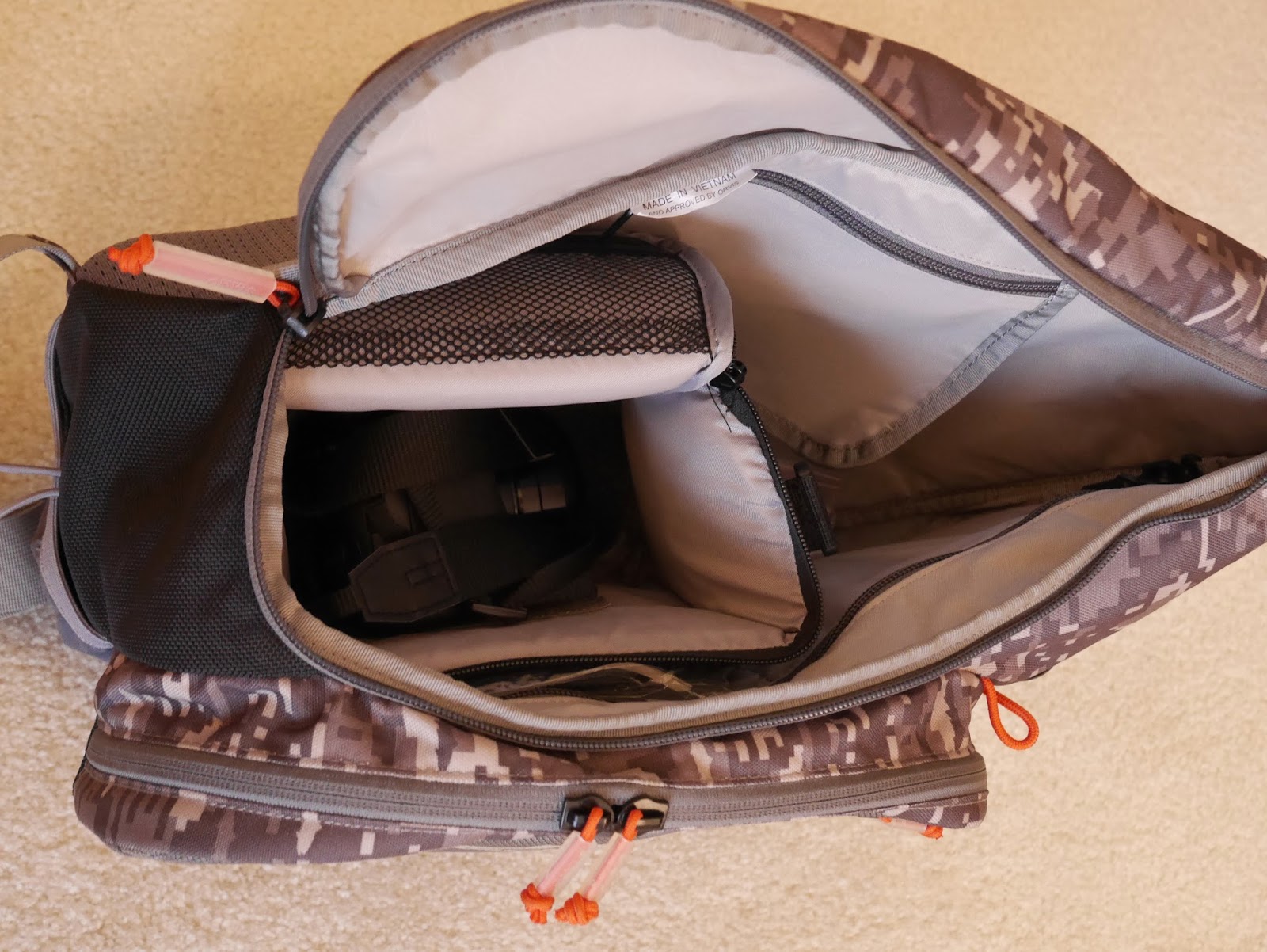
When I decided to get back into birding I was looking for a good pack that would allow me ready access to my gear - camera, guide(s), etc. A regular pack was too inconvenient to take off when wearing binoculars. The more I thought about it, the more I thought that the Guide Sling Pack might be the perfect solution.  It was.  The end. (Hemingway would like those crisp, short sentences, but my posts would be way too short, so I continue.)

The pack has a main section and two other zippered pockets. The main part of the pack opens into a large compartment. This space is large enough for a good-sized camera with plenty of room left to tote your binoculars or lunch. At the far left of the picture is a mesh pouch for water bottle (for those who drink water).

The largest pocket is big enough for the Sibley Eastern U.S. field guide and another, slightly smaller guide. I also keep a small voice recorder in this pocket. Using a voice recorder can be a more convenient and quicker way of keeping track of birds than writing each one down.

I keep my "Rite-in-the-Rain" hard-bound book and pen in the smaller front pocket along with Zeiss lens wipes. The book is a convenient 4.25" x 6.75" and the pages are waterproof. The pen has waterproof ink, won't freeze and can write from any angle. The book and pen are the perfect combination for writing field notes in any kind of weather.

To the left is a picture of all the stuff I typically take with me when I head out the door into the field, minus my binoculars. So far the outfit seems to work very well and I don't see a replacement pack in my future.

An added benefit to this set-up is that I also have a Guide-sized sling pack for fly fishing. I'd argue that this dual purpose makes the whole purchase economical as well. I can see how certain spouses might disagree with this view.

Sunday, February 22, 2015

Fly Tying Redux

My first Salmon fly - the pheasant-winged head-knocker
When I started tying flies back in my 20s some people thought they were too large to be practical. Maybe I'd have better luck knocking out a fish than I would have in actually hooking one. Such hurtful words were painful and launched my 20+ years of suffering from fly-tying PTSD. My only form of solace was, of course, my mother.

Once I determined that I was tying-challenged and suffering from PTSD, I did what any American man would do, I went to my mother. Much to Mom's surprise she received a fly-tying kit from me for Christmas. At first she thought it was a bad joke. Soon, however, she had signed up for fly-tying classes and was turning out some really beautiful flies - wet flies, dry flies, all kinds of flies. They actually looked like the pictures in the books.

Unfortunately, after almost two decades of cranking out flies, Mom decided to retire the fly vise. It was a sad day when the Boushies had to once again purchase commercial flies. It did cause me to revisit the status of my PTSD. After years of quiet therapy, I decided I was ready to relaunch my fly tying. Besides, I thought that maybe using a lot of Mom's fly-tying supplies and tools would be good karma.

My reentry into the world of wrapping thread around a naked hook began in early February when I signed up for Orvis's (free) Fly Tying 101. Not only could I revisit the basics, but I would also receive two coupons and walk home with whatever I was able to tie.

The tying class was taught by Dan Davala, Orvis Fishing Manager, and James Kammel, a fly fishing guide and owner of Catcher & the Fly. There were about 6 other tyers and me in the class. Ages were from the early teens (twins brought by their grandfather) to early 50s. The class was about half women.

Dan gives the introduction
Instruction started with the very basics, wrapping thread on the hook and tying off the fly with a whip finish knot. It was interesting and a bit entertaining watching people who have never seen a whip finishing tool trying to tie a whip finish knot. Eventually, most seemed to get it.

After the very basics were mastered, which took the better part of an hour, we moved to tying our fist flies - a woolly bugger. Wrap the threat, tie on the marabou tail, tie on the chenille, tie on soft hackle, wrap chenille, wrap hackle, tie off at head, add head cement...done. Simple enough. I tied two respectable flies and think that I may be on the road to tying PTSD recovery. Only time with tell.

Remember, I said respectable, not good. I still have a few patterns to figure out and may retain Dan's services for a couple private lessons.

Things went well enough for me to spend the balance of an Orvis gift certificate on tying materials. I'll have to show up in NY this year on our fishing trip with flies for my dad and brothers.

Let the tying begin. I don't know that I'll get as good as Mom, but if I can catch some fish with my flies I'll be pleased enough.

Dan helping woman use the whip finishing tool

Friday, February 20, 2015

You're Never Too Old to Learn

I was disappointed in the performance of the plastic clip on the tree strap that came with the Bushnell® HD Trophy Cam. Disappointed in the way it broke in the cold. My solution was to use an old kayak tie-down (left). OK, confession, it wasn't old, but it was available and I could replace it by the time it was warm enough to kayak in Vermont.

It is generally a good idea to question your own cleverness. The new strap was great and it did a phenomenal job. I wondered why Bushnell® was so "thrifty" as to not include such a fantastic strap initially. Unfortunately, man-genius here never got past what a great solution I'd come up with to consider other issues, such as why Bushnell® include a strap that was a little less visible.

After I reattached the camera to a tree, I left to run some errands. When I was driving up the driveway on my way home I spied a bright yellow ribbon around a tree. Unfortunately (or fortunately), we weren't praying for the return of a loved one, or Tony Orlando. I guess you can attach your game camera to a tree using a bright yellow strap if you'd like for the game cam to be stolen. I'm sure the raccoons had a great laugh that night.

I took the camera down and ordered a dark strap from Amazon. Now it is securely attached, easy to adjust, and won't be broken by the Vermont weather.

I chalk it up as an ultimate win, but I had to laugh at myself for overlooking the obvious. Of course, once the obvious was mounted on a tree, it was easier to see.

I was also educated a couple weekends ago. Every Sunday at 8 AM a group meets down at a park in Virginia to bird. I decided to go to the same spot on Saturday to try out a "new" spotting scope I was renting for a couple days. I was slow getting out, but 8 AM seemed too early on the weekend anyway. I decided to hit Huntley Meadows Park first. It was pretty much a bust as far as seeing a variety of birds, but there were a lot of Mallards and Canada Geese. What I learned was how difficult it is to identify ducks when they are all resting with heads tucked under wings. I also learned that, at the right angle, a Mallard drake's head looks purple - not green. I confirmed this observation at the National Zoo the other day on a noon-time walk.


My final observation and lesson learned is that it is really quite difficult to take an iPhone photo through a spotting scope (right). It is hard to line up that small lens with the small scope eyepiece. At least you can see the ducks with their heads hidden. There must be an easier way to line up the iPhone camera and the scope...perhaps a bright yellow strap would work. I have one that I'm not using and is now far too short to tie down a kayak.

Wednesday, January 14, 2015

Naked and Afraid of Fat Guys in the Woods with River Monsters

My name is Kristopher Boushie and I have a late-night television problem. It is an accepted fact that most people need a solid eight hours of sleep every night to stumble through life barely conscious of their surroundings. I, however, due to my unique genetic make-up and dietary intake, can stumble through my day on less than six hours of sleep. My reduced slumber provides me with additional time in my day to worry about an unending number of actual, potential, and imaginary misfortunes. I can also use this extra time more productively by watching marathon sessions of several "outdoor" shows - Naked and Afraid, Fat Guys in the Woods, and, the purest of the outdoor genre, River Monsters.

Naked and Afraid. Each show features two strangers, a man and a woman, who choose one survival tool (knife, flint and steel, duct tape). They are then dropped in some God-forsaken corner of the world where they have to survive for 21 days, then make it to an extraction point to be picked up. Lots of bugs, snakes, rain, leeches, ticks, and dirt. There is no romance in this show - naked or not. I particularly liked the guy who showed up in the jungle with duct tape. The first thing his partner had him make her was a bikini. The couple is supposed to have some survival training, but it may only consist of shopping at Whole Foods for a week. Here is the thing, these people are not fat. They actually need to eat and there is never enough food. Some get darn skinny. I'm thinking of trying to get on the show to shed a couple pounds myself. The show is on the Discover Channel.

Fat Guys in the Woods. "Survival is simple, just don't die." It is a great tag line. Unlike the "Naked" people, these guys can skip a few meals. In most episodes the grub is scarce (and may actually be a grub). The three fat guys are taught survival skills by "Creek," the thin, blond-haired, pony-tailed guide. The goal is to survive five days in the mountains - four days with Creek and one night alone. The last night the guys have to build their own shelter and start their own fires. While they may not be naked, a good thing, most are pretty afraid. They clearly are not used to being away from TV, fast food, or a warm bed...and for that reason it is pretty entertaining. This show is on the Weather Channel.

Where the real river monsters are!
River Monsters. OK, the photo to the left isn't from the show. It's my dad, grandpa, and friend fishing in the Adirondacks. To hear those old fishing stories, there were river monsters back then!

This is the most addictive of the shows. I'm good for only a couple episodes of "Naked" or "Fat Guys," but I can watch Jeremy Wade all night. I'll watch an episode or two or three, then look up and it's after midnight. Then I dream of how I can possibly get his job. I haven't figured out a solution to this yet, but I am working on it.

Jeremy Wade with friends
This guy fishes all over the world, but spends most of his time in South America and the Amazon. He seems to speak fluent Spanish, so I will need to bring Karen with me as my fishing translator, but not my sound man. Jeremy Wade's sound man got hit in the head by lightening, so it seems dangerous. The guy was OK - good thing since they couldn't get him out right away. Except for the constant rain, bugs, sweltering heat, and fish that could kill you, it looks like a lot of fun. River Monsters is on the Animal Planet.

I've found another pastime when I'm not getting my eight hours of sleep...writing blog posts. I look up and it's already almost 11 PM. It is almost time to turn to the work work I brought home from the office - more writing, but not as much fun because you have to cite everything...rather than just make it up as you go.

If you want to sleep well don't combine dreams of  naked fat guys and river monsters or you will certainly be afraid. Sweet dreams.

Wednesday, December 17, 2014

Magna Anno, a Big Year by any other name, or hunting without a gun

Barred Owl from Huntley Meadows Park in VA
Step one, watch The Big Year movie with Steve Martin, Owen Wilson, and Jack Black.
Step two, get a couple of your friends together to hold your own (very little) Big Year birding competition.
Step three, have at it for bragging rights...and it is a pretty healthy diversion.

First, we should define a Big Year. A Big Year, according to Wikipedia (which contains the sum total of all human knowledge), "is an informal competition among birders to see who can see or hear the largest number of species of birds within a single calendar year and within a specific geographical area. A big year may be done within a single US state, a Canadian province, within the lower 48 continental U.S. states, or within the official American Birding Association Area (defined as the 49 continental U.S. states, Canada, and the French islands of St. Pierre and Miquelon, plus adjacent waters to a distance of 200 miles from land or half the distance to a neighboring country, whichever distance is less. Excluded by these boundaries are Bermuda, The Bahamas, Hawaii, and Greenland)."

Great Blue Heron
Now, granted that Canada isn't too far from Vermont, but do we want to have to contest with an overly competitive birder jetting off to Alaska to add some unique bird species? Hint - no we do not. The same goes for the "French islands." Another issue with the original rules - to "see or hear the largest number of species of birds...." Most of my guy friends can't hear his own wife in the next room. I'm supposed to let him vouch for the fact he heard a Gray Catbird and not a Northern Mockingbird? I don't think so.

LBB or LBJ (little brown bird or little brown job)
Our rules are that you must see and identify the bird in the lower 48 states and surrounding waters. Zoos and pet birds don't count. All bird sightings to be counted need to be entered on Cornell University's eBird site. (Registration is free and the information is used by scientists in tracking bird species distributions and migration information.)

The eBird site has an unbelievable amount of information. For example, I'm interested in seeing a Snowy Owl, a bird I have never seen. I can go to eBird, look under explore data tab, then species maps. I enter the species I'm interested in and the location (in this case a ZIP code). The result is a map with sighting locations identified. Note that on this map (below) there was a sighting near Lang Farm in Essex, Vermont on December 16th, yesterday. Just imagine if they had the eBird equivalent for 8-point bucks?! Right, there'd be no 8-point bucks left.

On the off chance you spot some interesting bird, you can add it to the eBird sightings (after setting up a free account). Then when someone hovers the cursor over your map pin they will see your name and sighting.

eBird screen shot of Snowy Owl sightings near Jericho, Vermont
eBird is a great aid to help locate birds. However, it is no guarantee that the bird will be there when you arrive. That is where the hunting comes in to play. You will usually need to spend some time in the field or woods to spot the particular bird you are stalking. It is a great excuse to get outside and observe.  You may even find that 8-point buck, just don't mark it on eBird.

Interested in joining our little big year? Just send me a response to this post and I will add you to the currently very short list. You can follow our progress on Twitter at @sportingafield. I will post progress a couple times a month, along with links to any interesting pictures we take.

Saturday, December 13, 2014

Bearly Thanksgiving

My family and I spent a lovely Thanksgiving at my brother Jim's house in Woodbury, Connecticut. We were outside setting up for our annual archery tournament and the kids and I discovered some interesting tracks in the backyard. Being trained scouts, they started following the tracks by carefully walking directly in the tracks. I managed to take this picture with my iPhone before it was stomped out.

My nephew, Jack, was the lead tracker. He followed the tracks under the porch. That made me a bit nervous since we couldn't see that there were exit tracks and under the porch would be a great place to sleep for the winter.

The bear just checked out the garbage can and moved on around the house and into the next yard.  It was something we didn't expect to see in suburban Connecticut.

The trophy held hostage in New Hampshire
It was an underwhelming second annual Boushie archery tournament. The champion from last year, niece Jessica, was unable to defend her crown due to bad weather. As for the competition this year, let's just say that very few of the arrows found the actual target, never mind the bulls eye. Arrows had to be retrieved from everywhere. (Good thing there wasn't a bear around and we had to defend ourselves. It is possible that the bear could have stepped on an arrow.

This year we were joined by Pat, my daughter Maddie's boyfriend (third from the right in the dinner picture below). What we didn't know was that Pat was a ringer. He taught kids archery in summer camp. OK, he wasn't much of a ringer. Truth was the competition was rather lacking. As I said, few arrows found the target. Besides we just wanted to make Pat feel welcome. Personally, I think he would have felt just as welcome in second place.

Indian princess aiming
bird-frying chef takes aim
I was able to defend my runner-up crown and there was no trophy to be given to Pat. Not because he didn't win, but because there literally was no trophy to give him. It was still in New Hampshire. That took care of the dilemma of what to do when a non-Boushie wins the Boushie archery trophy.

I think Jim and Pam were very happy to get their house back. The jury is still out on where the 2015 third annual Boushie archery tournament will take place. The first thing we have to do is get the trophy back from New Hampshire. The second thing we have to do is practice! I haven't shot a bow since the tournament last year. It was a sad showing. Perhaps I will make a trophy for second place - I would have won it two years in a row.

the crew, from left to right, front row, then back, daughter Katie, nephew Jack, niece Emma, me (Uncle Donut - my indian name), wife Karen, pa-in-law Norm, mom Althea, dad Sherdan, sister-in-law Pam, bro Jim, former archery teacher Pat, and indian-princess-daughter Maddie